
Globalaw - Home
ContactMember Login
Our social network
Tax Disputes in Italy: A Guide
Insights

Tax Disputes in Italy: A Guide

By Paolo Comuzzi, Tax Partner, Milan, Lawal Legal & Tax Advisory, 07 Aug 2026

This summary outlines how tax disputes arise and proceed in Italy, covering the self-assessment system and taxpayer registration, how the tax authority reviews and challenges returns, the treatment of tax fraud, the conduct of audits, options for resolving disputes before litigation, the appeal process through the tax courts, and the penalties and areas of dispute taxpayers are most likely to encounter.

Tax Registration

In Italy, every individual and legal entity receives a tax identification number. Legal entities and partnerships are always assigned a VAT number, while individuals receive one only if they engage in business or self-employment activities, not for salaried employment. Once a taxpayer holds a VAT number, the tax authority is fully aware of that person's existence and economic activity.

Self-Assessment and Amending Returns

The Italian system operates on self-assessment: taxpayers prepare and file their own annual returns, and the tax authority has five years from the following year to review the return and challenge any errors or omissions. A late challenge is null and void, though the taxpayer must still formally seek its annulment through an administrative appeal or legal action.

Returns may be amended to report higher income at any time before an assessment notice is served, substantially reducing potential penalties, or amended to report lower income, subject to specific time limits.

Assessment Notices and Time Limits

The tax authority must issue a reasoned assessment notice that sets out the factual and legal grounds for the challenge, which provision was violated and why, and separately justify any related penalties. In principle, notices must be issued within five years of the filing year (a 2025 return can be assessed until December 31, 2031).

Notices issued later can still be challenged: the taxpayer files a self-protection request for annulment and, failing that, a formal appeal within 60 days, citing the expiration of the deadline.

Tax Fraud

Tax fraud is a criminal, not an administrative, matter, defined by two articles of criminal tax law that cover the use of false invoices (documents recording costs for services never rendered) and other deceptive practices intended to mislead the authorities. It is punished severely, and if charges are filed, the deadlines for serving assessment notices are doubled. It is particularly relevant internationally—for instance, regarding management fees, where Italian companies can struggle to obtain precise supporting documentation for intercompany services. Fraud investigations are conducted by the local public prosecutor, assisted by the Guardia di Finanza under the Code of Criminal Procedure, and may involve restrictions on personal liberty and the seizure of assets. Tax and criminal proceedings run in parallel and both require careful handling

Audit Conduct and Standards

There is no formal code of conduct for audits beyond a general duty of fair cooperation. The Guardia di Finanza has issued a manual outlining audit procedures, and taxpayer rights are set out in the Taxpayer's Charter. Audit reports must invite the taxpayer to provide documentation, note the right to be assisted by a tax lawyer or Chartered Accountant, and state that withheld documentation cannot later be used in court. Audits now typically focus on three main risk areas for multinationals: transfer pricing, interest/dividend/royalty payments and beneficial ownership, and intercompany services.

During audits, inspectors may request any relevant documents, including those from foreign subsidiaries via international information exchange; a refusal generally bars later use of those documents in court. Requests to third parties to cross-check data (e.g., verifying that invoices were recorded by the issuer) are also routinely permitted.

Pre-Litigation Settlement Options

Before litigation, taxpayers have three main options: accept the audit report and pay in full to secure a significant penalty reduction; take voluntary corrective action on specific issues; or negotiate a settlement with the tax authority ("accertamento con adesione"). If none of these options succeed, the only remaining route is the courts, where judicial settlement may still be attempted. The audit relationship is governed by the Taxpayer's Bill of Rights; taxpayers should always respond carefully and in writing. Auditors may remain on the taxpayer's premises for up to 30 days (extendable to 60), though in practice the overall audit, including off-site document review, often takes three to four months.

The Appeal Process

A taxpayer has 60 days from the date of service of an assessment notice to appeal, first to the Revenue Agency that issued it and then, within 30 days, to the Tax Court of First Instance. The appeal must include all arguments at the outset, as further objections cannot be added later. First-instance hearings in Milan take about nine months; the losing party may then appeal to the Second-Instance Tax Court and, finally, to the Court of Cassation, which reviews only legal principles and the soundness of reasoning.

The Tax Court is an independent judicial body covering all tax and related charges. Hearings and judgments are public, and Court of Cassation decisions are published on its website. The procedure is mainly written, with only brief oral argument; the appeal must concisely set out procedural and substantive objections, which may later be clarified—but not expanded—in further briefs. Written documentary evidence is admissible; witness testimony is not generally central, though it can matter in specific disputes, such as demonstrating non-payment.

Burden of Proof

On the burden of proof: the tax authority must justify its challenge in detail (e.g., explaining why an expense should not be considered business-related), while the taxpayer must substantiate the item's legitimacy and show that the authority's findings are unreasonable; the authority cannot rely on generic, unsupported challenges.

Duration and Payment Obligations

Proceedings can be lengthy—up to about 12 years from assessment to a Court of Cassation decision in complex cases. Upon assessment, taxpayers must pay one-third of the additional tax claimed; a stay of payment is possible but difficult to obtain, requiring both urgency (periculum in mora) and a reasonable likelihood of success (fumus boni iuris), and is particularly hard to secure for large corporations, banks, or insurers.

Representation, Costs, and Alternative Dispute Resolution

Representation before the first two levels of the tax courts must be by qualified professionals, and for cassation proceedings, by an attorney qualified before the Court of Cassation. It is advisable to use a Chartered Accountant and a tax lawyer together. The losing party generally bears the costs of the proceedings. There are two levels of tax adjudication before the Court of Cassation.

For international disputes, particularly transfer pricing, arbitration (conventional or EU) is available to avoid double taxation. Purely domestic disputes have no alternative to litigation apart from mechanisms like "accertamento con adesione."

Penalties

Penalties for additional assessed tax are generally 70% of the tax due, plus interest. Penalties may be mitigated or waived in cases of objective legal uncertainty, assessed on a case-by-case basis; for transfer pricing specifically, penalties can be avoided by preparing appropriate documentation in advance.

Outlook

Looking ahead, the main areas expected to generate disputes are tax avoidance (abuse of right), transfer pricing, and beneficial ownership. No single area is seen as uniquely difficult, though the relationship with tax authorities remains complex: local offices are sometimes aggressive, rely on one-sided ministerial circular interpretations while disregarding contrary case law, and case law itself is not always fully consistent.

For more information, contact:

Image

Paolo Comuzzi, Partner

Lawal Legal & Tax Advisory

Latest News

news
10 Nov 2026

Globalaw Elects C. David DeBenedetti as President, Adds Two Board Directors

Globalaw is pleased to announce that C. David DeBenedetti, Partner at DeBenedetti Majewski Szczesniak in Warsaw, Poland, was elected President of the network at the 2026 Globalaw Annual Members Meeting in Austin, Texas. DeBenedetti succeeds Peter J. Brown, Partner at Edwards, Kenny & Bray, and will serve a two-year term.

DeBenedetti has served on Globalaw’s Board of Directors since 2011 and on the board of the American Chamber of Commerce in Poland since 2022, where he has served as vice chair since 2025. A New York-qualified attorney who has practised in Poland for nearly three decades, he co-founded DeBenedetti Majewski Szczesniak in 2004 and advises domestic and international clients on cross-border investments, mergers and acquisitions, and special situations.

“I am honoured to serve as President of Globalaw and grateful to our members for their trust,” said DeBenedetti. “On behalf of the board, I want to thank Peter for his leadership over the past three years. His commitment to our members and dedication to the network have strengthened Globalaw’s foundation and elevated its international position. I look forward to working with our board and member firms to deepen collaboration and help our delegates serve their clients across borders.”

Globalaw also welcomes two new members to its Board of Directors:

  • Gordon Hearn is a partner at Gardiner Roberts LLP in Toronto, Canada, where he co-chairs the firm’s Transportation and Logistics Group. A past President of the Transportation Lawyers Association, he is recognised by Chambers Canada, The Legal 500 Canada and Best Lawyers in Canada.
  • Takashi Oguchi is a partner in the Osaka office of Chuo Sogo LPC in Japan. He advises on domestic and cross-border M&A, from pre-acquisition through post-merger integration, as well as international business contracts, and represents banks, manufacturers and real estate companies in litigation and dispute resolution. He is listed in The Best Lawyers: Ones to Watch in Japan 2027.

In addition, Anthony Yang, Managing Partner at Stellex Law Firm in Taiwan, has been elected an Officer of the board and will chair the Branding and Sponsorship Committee and co-chair the Membership Engagement Committee.

Globalaw Board of Directors:

Officers

  • President: C. David DeBenedetti, DeBenedetti Majewski Szczesniak
  • Peter J. Brown, Partner, Edwards, Kenny & Bray
  • Oliver Foerster, Huth Dietrich Hahn
  • Julia Holden Davis, Gunster
  • Bryan C. Birkeland, Jackson Walker LLP
  • Clay Hix, Hill, Farrer & Burrill LLP
  • Arveen Arabshahi, Davidson Chalmers Stewart LLP
  • Michael Hatchwell, Gunnercooke
  • Anthony Yang, Stellex

Directors

  • José Luis Gutiérrez-Azpe, Ramírez, Gutiérrez-Azpe, Rodríguez-Rivero y Hurtado, S.C.
  • Talal El Makkawi, Apex Juris Advocates & Legal Consultants
  • Bahar Ulgen, Bener Law Office
  • Jonathan Cheong, Bagus Enrico & Partners
  • Ken Silverman, Olshan Frome Wolosky
  • Jessica Wang, Hinckley Allen
  • Piergiorgio Mancone, LawaL Legal & Tax Advisory
  • Gordon Hearn, Gardiner Roberts LLP
  • Takashi Oguchi, Chuo Sogo

--

About Globalaw

Founded in 1994, Globalaw is a Band 1 Chambers-ranked global network of approximately 80 independent law firms and 4,000 lawyers in more than 60 countries. Our mission is to foster seamless legal collaboration among member firms and help them deliver high-quality, cost-effective solutions to clients worldwide. We take pride in our commitment to excellence, global reach and innovative approach to legal services. Visit www.globalaw.net to learn more.

Media Contact:

Jaime Luckey

marketing@globalaw.net

news
09 Nov 2026

Recap: 2026 Globalaw Annual Members Meeting

From 28 to 31 October, delegates from Globalaw member firms across Europe, the Americas, Asia-Pacific, the Middle East and Africa met at the Omni Barton Creek Resort in Austin, Texas, for the 2026 Globalaw Annual Members Meeting, hosted by our Texas member firm Jackson Walker.

The business programme brought together a distinguished group of speakers, including a former U.S. Senator, a retired state supreme court chief justice, senior business leaders, in-house counsel and member firm delegates. Sessions focused on the issues clients face today: growth and investment in Latin America, infrastructure and energy, board governance and global risk, cross-border disputes, and the practical use of AI in legal work. Our young lawyers took the stage to discuss who will lead law firms in 2040 and our member firm leaders shared their ideas and perspectives during the Managing Partner forum.

The social programme brought Austin’s spirit to life with true Texas hospitality, featuring a welcome dinner on Bryan Birkeland’s wonderful ranch, two-step lessons, our signature gala with live music and dancing, and a UT-Austin tailgate and football game.

We are thankful to our sponsors, Legora, AESIS, MDD Forensic Accountants, PBV Insights, Intapp, Trailrunner, and PipelinePlus, for their generous support in making this meeting possible.

Giving Back Where We Gather

Continuing our tradition of supporting a charity in each host city, the Globalaw Foundation presented a $5,000 donation to the San Antonio Legal Services Association (SALSA). The Foundation gives back to communities and organizations in need, with a focus on legal education and access to justice. SALSA is a corps of attorney volunteers coordinated by professional staff to provide free civil legal services to those with limited means and those who are vulnerable or at-risk. Last year it served more than 630 clients, supporting veterans, families and individuals with disabilities.

Image

Where to Next?

GWI Meeting in Iceland, March 3-6, 2027

Americas Regional Meeting in Mexico City, April 8-10, 2027

APAC Regional Meeting in Seoul, June 3-5, 2027

Annual Members Meeting in Milan, November 3-6, 2027

news
01 Nov 2026

Member Spotlight: Zvi Tamir & Co.

Six Decades of Guiding Business Beyond Borders

For more than 65 years, Zvi Tamir & Co. has helped clients navigate complex commercial, corporate and cross-border legal matters in Israel and beyond. Founded in 1959 by Dr. Zvi Tamir, the firm has earned a reputation as a trusted advisor to Israeli and international clients alike, combining deep legal and cross-border business expertise.

Based in Bnei Brak Business Centre, Israel, the firm has built its practice around supporting Israeli companies as they expand globally while helping international businesses establish successful operations and relationships in the country.

Where Legal Strategy Meets Commercial Reality

Entrepreneurs, growing companies, and established businesses turn to Zvi Tamir & Co. for legal advice and strategic guidance aligned with their commercial objectives. The firm advises clients across a broad range of areas, including corporate and commercial law, mergers and acquisitions, cross-border transactions, intellectual property, technology and licensing, commercial litigation and dispute resolution, real estate and investments.

Zvi Tamir & Co. has advised on significant cross-border transactions, investments, disputes, and commercial relationships involving parties across North America, Europe, Asia, and the Middle East. Whether representing multinational corporations, growth-stage companies, investors, or private clients, the firm's approach is grounded in understanding the commercial realities behind every matter. Clients benefit from advice that is both legally sound and strategically focused on achieving business goals.

A Tradition of Personal Service

Chairman and firm leader Erel J. Tamir has more than three decades of experience across corporate law, commercial transactions, intellectual property, and litigation. Under his stewardship, the firm has remained committed to personal attention, accessibility, and long-term client relationships.

Clients work directly with experienced lawyers who take the time to understand their businesses, challenges, and ambitions, ensuring that legal advice is tailored to their specific needs rather than a one-size-fits-all approach.

Trusted Counsel for Complex International Matters

Zvi Tamir & Co’s experience handling multinational transactions and complex international matters enables it to guide clients through the legal, regulatory, and cultural considerations that often accompany cross-border growth. Whether assisting with acquisitions, strategic partnerships, market entry, or dispute resolution, the team brings a globally minded perspective to every engagement.

The firm’s recent notable international assignments include a major transaction involving the sale of a group of core mid-market companies operating across three continents to a leading investment fund; successfully defending an international mining group in cross-border litigation involving both private and public international law and foreign state immunity, spanning more than ten proceedings across four judicial levels and establishing significant precedents; and successfully defending a foreign investment fund against disclosure-related claims concerning its overseas marketing of Israeli securities, and settled before a hearing on the merits, with no out-of-pocket payment by our client.

The firm also represented a group of non-resident owners holding rights in some of the most valuable and strategically significant land reserves in central Israel, securing significantly higher proceeds for our clients than other rights holders obtained through litigation and negotiations.

Strengthening Connections Through Globalaw

As a founding member of Globalaw, Zvi Tamir & Co. is the network’s exclusive Israeli representative and previously hosted the network’s annual members meeting in 2011. Embracing the value of building long-term international relationships, the firm’s recent collaborations with Globalaw members include supporting a real estate investor requiring intensive, hands-on assistance; arranging an in-person consultation for a niche retail chain planning its expansion; obtaining regulatory advice for a client in the medical sector; and handling a copyright matter.

For Zvi Tamir & Co., the network's true strength lies in trusted professional relationships that enable members to work together efficiently and effectively on behalf of clients.

Visit www.tamirlaw.com for more information.

Insights
21 Oct 2026

Data Processing Agreements Across Asia Pacific: Divergent Rulebooks, One Practical Problem

Data Processing Agreements ("DPAs") have become an increasingly important part of managing personal data processing arrangements, particularly when organisations engage third-party service providers to process personal data on their behalf. DPAs typically set out the scope and purpose of processing, the parties’ respective responsibilities, security and confidentiality obligations, and requirements for sub-processing, data breaches, and the return or deletion of personal data.

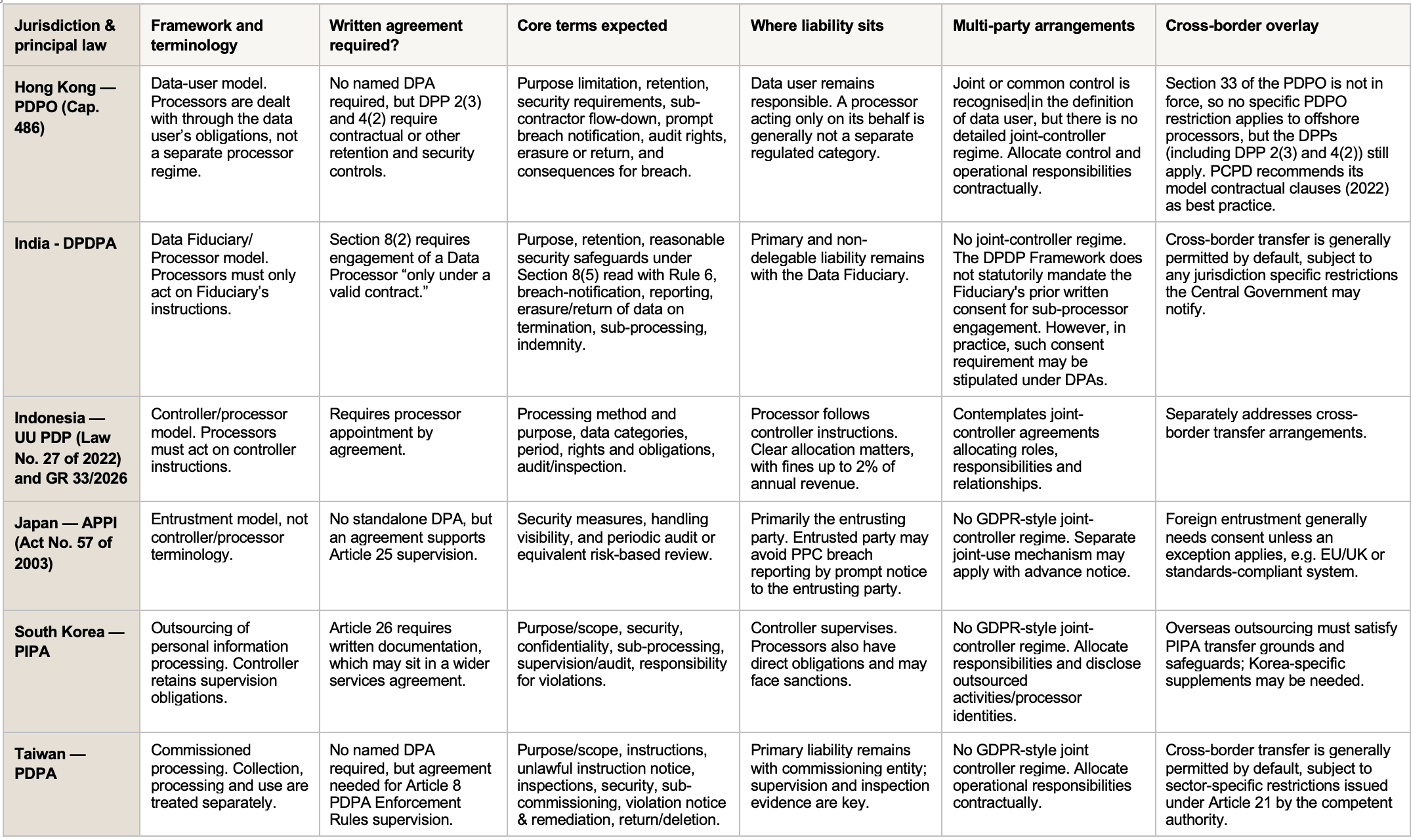
Requirements vary across jurisdictions. Some expressly require agreements between controllers and processors and prescribe specific terms; others rely more heavily on general data protection obligations and contractual practice. Multi-party arrangements and cross-border transfers are also treated differently. This article summarises the position in Hong Kong, Indonesia, India, Japan, South Korea, and Taiwan, presents them side by side, and closes with practical considerations for organisations operating across the region. With data protection enforcement intensifying across the Asia-Pacific region, understanding these jurisdiction-specific nuances is essential for businesses to manage legal risk and structure compliant cross-border arrangements.

Hong Kong

Hong Kong’s Personal Data (Privacy) Ordinance (Cap. 486, "PDPO") regulates "data users" rather than imposing a GDPR-style controller-processor regime. A processor acting solely on behalf of a data user is generally not treated as a separate category, but the data user remains responsible for compliance with respect to outsourced processing. Contractual control is therefore central. Data Protection Principles 2(3) and 4(2) require a data user engaging a processor, whether in Hong Kong or elsewhere, to adopt contractual or other measures to prevent excessive retention and unauthorised or accidental access, processing, erasure, loss, or use of the data. The Office of the Privacy Commissioner for Personal Data (“PCPD”) has issued practical guidance on what those measures should be. Its Guidance Note on Data Security Measures for Information and Communications Technology (August 2022) recommends that data users engage only competent and reliable processors, specify security requirements in the contract, require immediate notification of data security incidents, conduct audits, and impose consequences for breach of contract. Its guidance note on cloud computing (revised January 2025) adds that the contract should limit use of the data to the original collection purpose, extend the same protection to subcontractors, require timely breach notification, provide for erasure or return of the data on request or on termination, and not allow the provider to lower its standards unilaterally.

In the cross-border context, section 33 of the PDPO, which would regulate transfers of personal data outside Hong Kong, has not been brought into operation. Therefore, the PDPO imposes no specific restrictions on engaging a processor outside Hong Kong, and the general Data Protection Principles, including DPP 2(3) and DPP 4(2), continue to apply. The PCPD has nonetheless set out best practice in its Guidance on Recommended Model Contractual Clauses for Cross-border Transfer of Personal Data (May 2022), which includes clauses for transfers from a data user to a data processor covering use only for designated purposes, agreed security measures, erasure, and restrictions on onward transfer and sub-processing, and recommends adding reporting, audit, and breach notification terms. Since the PCPD treats their adoption as evidence of due diligence that will be considered in any suspected breach, data users are well advised to follow them when engaging processors outside Hong Kong.

India

India's Digital Personal Data Protection Act, 2023 (“DPDPA”) and Digital Personal Data Protection Rules, 2025 (“DPDPR”) (collectively, the “DPDP Framework”) impose primary compliance responsibility on the “Data Fiduciary” (the entity determining the purpose and means of personal data processing), making contractual arrangements with “Data Processors” essential for managing statutory liability. Section 8(2) of the DPDPA requires a Data Fiduciary to engage a Data Processor “only under a valid contract,” making formal DPAs mandatory for businesses operating in India.

In the interim period before the DPDP Framework becomes fully operational, such businesses should take proactive steps toward compliance, including executing appropriate DPAs. A robust DPA should mirror the Data Fiduciary’s obligations under the DPDP Framework, including reasonable security safeguards under Section 8(5) of the DPDPA read with Rule 6 of the DPDPR, sub‑processing arrangements, breach notification mechanisms, and obligations for erasure or return of personal data. Since Section 8(1) of the DPDPA makes the Data Fiduciary liable “irrespective of any agreement to the contrary,” an indemnity clause in the DPA is also essential. This is particularly important because substantial penalties (up to approximately USD 26.5 million) are prescribed under the DPDPA for failure to implement reasonable security safeguards, underscoring the need for strong contractual recourse against Data Processors (and sub‑processors) in the event of a breach.

Indonesia

Indonesia’s Personal Data Protection Law Regulations (Law No. 27 of 2022, "UU PDP," and its implementing regulation, Government Regulation No. 33 of 2026. “GR 33/2026”) require data processors to process personal data on the instructions of data controllers. The UU PDP does not set out every term of a controller-processor agreement, but the implementing regulation expressly requires processors to be appointed through an agreement. That agreement should cover the method and purpose of processing, the types of personal data, the processing period, the parties’ rights and obligations, and audit and inspection mechanisms. The regulation also distinguishes agreements involving processors, joint controllers, and cross-border transfers. In a joint-controller setting, it contemplates an agreement allocating the parties’ roles, responsibilities, and relationship. This is not just a drafting point: administrative fines under the UU PDP may reach up to 2% of annual revenue, depending on the violation.

Japan

Japan’s Act on the Protection of Personal Information (Act No. 57 of 2003, "APPI") does not define "processing" as a legal concept and does not adopt the controller-processor distinction. The analogous concept is "entrustment": causing another person to handle personal data, regardless of the form of contract. Entrustment is important because, within the necessary scope of the purpose of use, it is excluded from the ordinary consent requirement for third-party provision under Article 27(5)(i). A standalone DPA is not mandated, but Article 25 requires the entrusting party to exercise necessary and appropriate supervision over the entrusted party. In practice, this means selecting an appropriate vendor, agreeing on security controls, and maintaining a reasonable understanding of how the data is handled through audits or equivalent review. PPC guidance confirms that the agreement does not need a prescribed form, that an on-site audit clause is not mandatory if supervision is effective, and that supervision should be risk-based. A narrow cloud-services exception may apply where the provider is not contractually permitted or technically able to access or handle the relevant data, although cross-border rules may still need to be considered. Obligations currently rest mainly with the entrusting party, but a pending amendment bill would expressly restrict entrusted parties from handling data beyond the scope necessary to perform the entrusted services.

South Korea

South Korea’s Personal Information Protection Act ("PIPA") regulates DPAs through outsourcing. Article 26 requires a controller that outsources personal information processing to document the arrangement in writing and include specified safeguards. The clauses may be included in a broader services or outsourcing agreement, but should address the purpose and scope of processing, security and confidentiality, limits on sub-processing, supervision and audit rights, and responsibility for violations. The controller remains responsible for supervising processors, and a processor may not further outsource without the controller’s consent. Korea also has a practical disclosure requirement that is easy to miss: controllers must generally disclose outsourced activities and the identities of processors, including relevant sub-processors, in a manner accessible to data subjects. Processors also have direct obligations under PIPA and may be sanctioned even when acting on a controller’s instructions.

Taiwan

Taiwan’s Personal Data Protection Act ("PDPA") addresses these arrangements through commissioned processing. The PDPA distinguishes among the collection, processing, and use of personal data, and under Article 4, a commissioned party is treated as acting on behalf of the commissioning entity. Primary regulatory liability therefore remains with the commissioning entity. Unlike the GDPR, Taiwan’s PDPA neither recognizes the concept of joint controllership nor adopts a formal controller-processor distinction. Furthermore, Article 8 of the PDPA Enforcement Rules requires proper supervision of the commissioned entity. Accordingly, any agreement governing commissioned processing should extend beyond a short confidentiality clause. It should cover the purpose, categories, scope, and period of the engagement; processing within instructions; immediate notification if an instruction appears unlawful; regular inspections with documented findings; security measures under Article 12 of the Enforcement Rules; restrictions on sub-commissioning; breach protocols; and the return or deletion of data upon termination or cancellation. Enforcement and sector-specific security inspections have intensified since the Personal Data Protection Commission was established.

Comparison: What Should the Contract Deal With?

Image

Practical Considerations

  • Use a global template carefully. A GDPR Article 28-style agreement may be a useful starting point for multinational businesses, but it should not be used as a one-size-fits-all solution. Pair a regional template with short local schedules covering the points that matter in each jurisdiction.
  • Use the local legal vocabulary. Calling everyone a "controller" or "processor" may be convenient, but it can be misleading in Japan, Taiwan, Korea and Hong Kong. The contract should make clear who gives instructions, who handles the data, who supervises, and who answers to individuals or regulators.
  • Make supervision something you can prove. Vendor review should not exist only on paper. Depending on the risk, parties should use questionnaires, certifications, audit reports, regular review meetings, site visits or incident-led checks, and keep records of what was reviewed and what was fixed.
  • Do not bury sub-processing in boilerplate. Korea requires controller consent for further outsourcing, Taiwan expects prior notice or approval controls for sub-commissioning, and Hong Kong requires contractual or other controls over processors. A standard "notify and object" clause should be checked against the strictest jurisdiction in scope.
  • Plan the exit before signing the contract. Return, deletion and certification procedures are often treated as end-of-project details. Agree on them at the outset, especially where the vendor stores copies, backups, logs or physical media.

Given jurisdictional differences in data governance, multinational businesses operating across multiple markets across the APAC region would be well served by tailoring their DPAs to each jurisdiction’s applicable framework. If you have any queries regarding how jurisdictional requirements apply to your specific arrangements, we would be happy to offer a complimentary 30 (thirty) minute consultation to address them.

Download Article PDF ↓

--

Globalaw’s APAC Data Privacy & Protection Taskforce comprises 13 law firms in the Asia-Pacific region with specialized expertise in advising international companies on how to implement and manage a multijurisdictional data protection program.

Taskforce member firms combine a strategic, business-minded approach with cross-border collaboration to help clients build and maintain sophisticated and resilient data practices, effectively mitigate and respond to incidents, and provide sophisticated representation to resolve disputes or regulatory investigations.

Explore the Globalaw APAC Data Privacy & Protection Taskforce brochure for more information and regional contacts.

Disclaimer: The information provided in this article is for general informational purposes only and does not constitute legal advice. Information, including laws and statutes, cited is subject to change and is accurate as of 08 September 2026, but readers should verify its current status. We and our member firms shall not be held liable for any loss and/or damage incurred by any person acting as a result of the information contained in this article. Reliance on this content is at the reader’s own risk, and no attorney-client relationship is formed by reading or acting upon this article. Always seek professional legal counsel to ensure compliance with applicable laws and regulations.